The Physical Origins of Scatter in the Dust Attenuation Scaling Relation of Star-Forming Galaxies: Star–Dust Geometry
Published in MNRAS, 2026
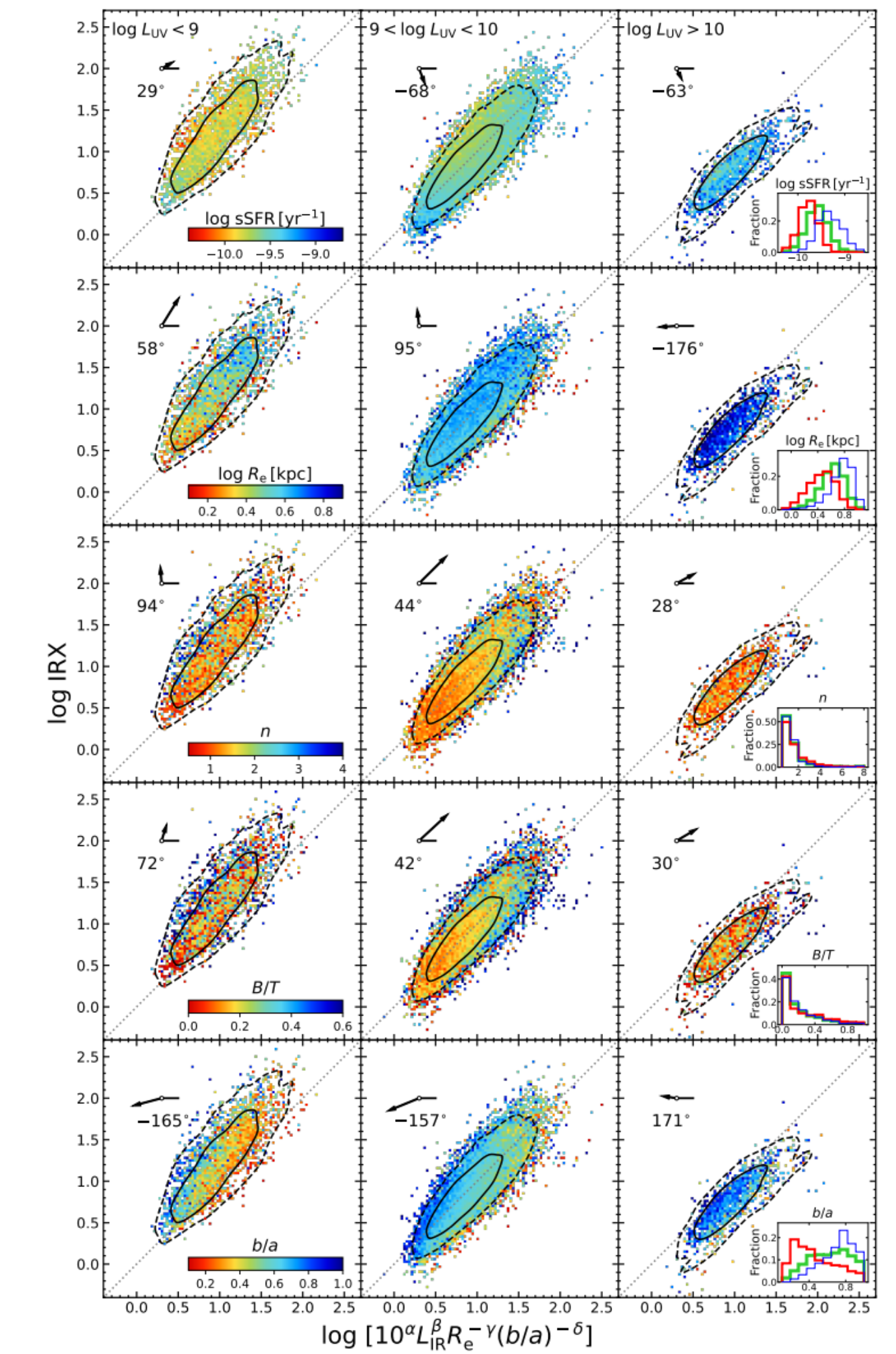
Characterising the physical drivers of dust attenuation in star-forming galaxies, Lyu investigates the origin of scatter in the infrared excess (IRX) relation using approximately 32,000 local galaxies from SDSS, GALEX, and WISE. The study shows that deviations from the relation are strongly linked to UV luminosity and can be largely explained by differences in star–dust geometry, including galaxy size and inclination. UV-faint galaxies tend to be compact and edge-on, while UV-bright galaxies are more extended and face-on, highlighting the role of geometry in shaping dust attenuation.
Recommended citation: Lyu et al. (2026) https://ui.adsabs.harvard.edu/abs/2026arXiv260932284L/abstract