Posts by Collection

proceedings

Evolution of dark matter haloes in CIELO simulations

Published:

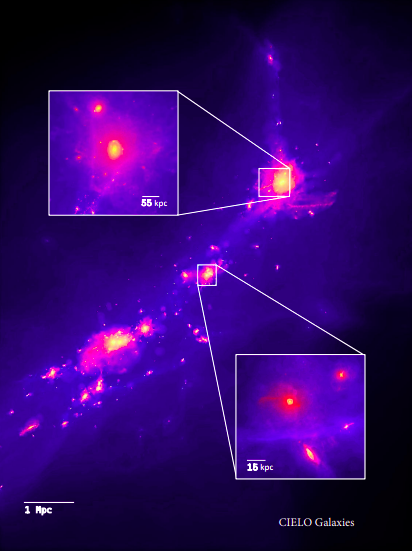
This article analyze the dark matter (dm) halo evolution through time. For this study we use a Milky Way like haloes subsample from CIELO (ChemodynamIcal propertiEs of gaLaxies and the cOsmic web) project. This project aims at studying the formation of galaxies in different environments using zoom-ins simulations.

Recommended citation: Cataldi et. al. (2023b) https://ui.adsabs.harvard.edu/abs/2023BAAA...64..178C/abstract
publications

Baryons shaping dark matter haloes

Published in MNRAS, 2020

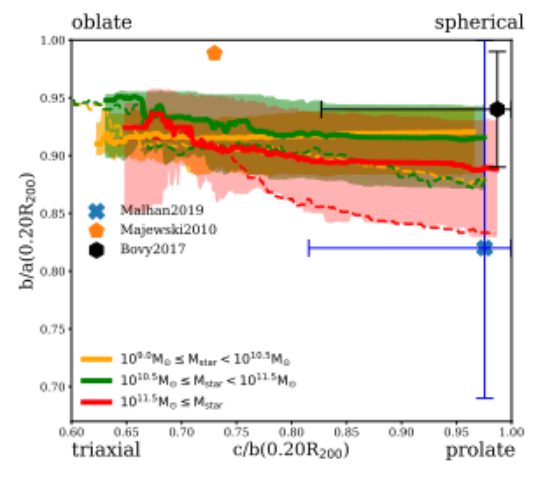
In this work we aim at investigating the effects of baryons on the dark matter haloes structure, focusing on the correlation between the presence and importance of stellar discs and the halo shapes. We study the properties of a subsample of DM haloes from Fenix and eagle cosmological simulations.

Recommended citation: Cataldi, et. al. (2020) http://dx.doi.org/10.1093/mnras/staa3988

Fingerprints of modified gravity on galaxies in voids

Published in MNRAS, 2022

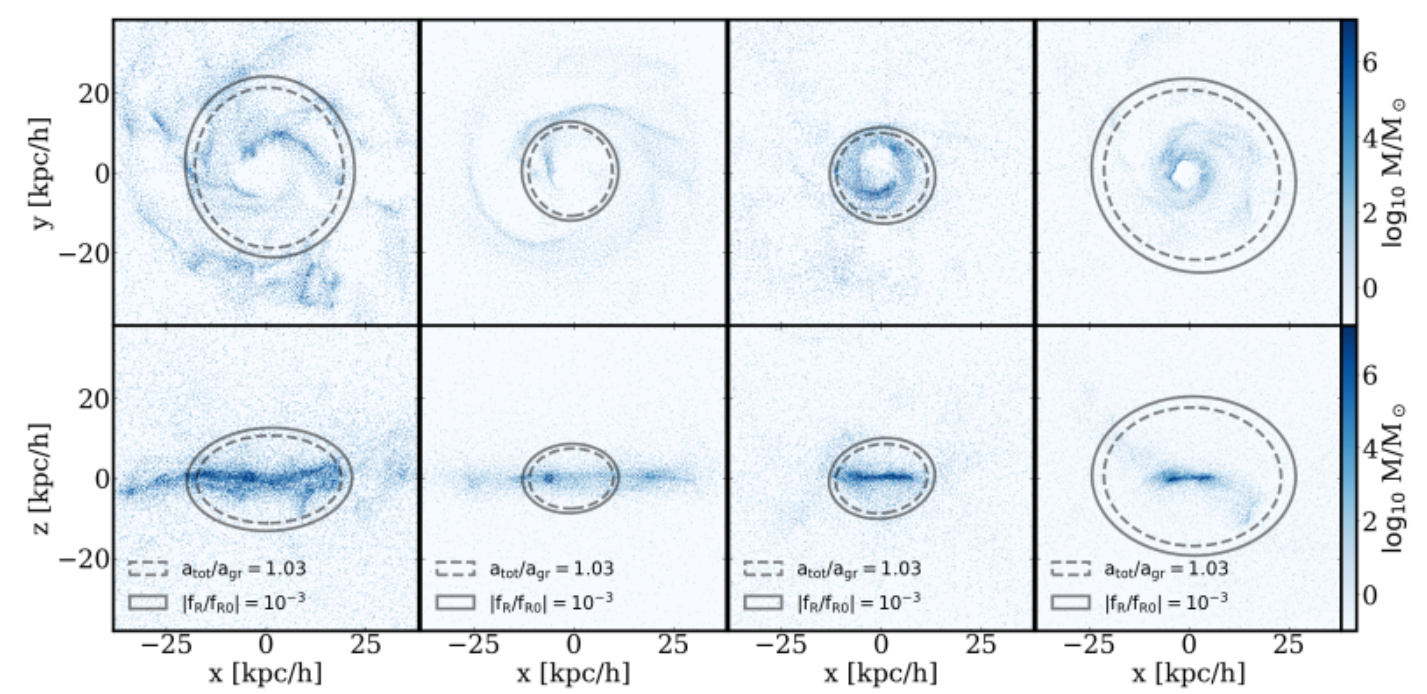
In this work, we search for detectable signatures of f(R) gravity and its chameleon screening mechanism in the baryonic and dark matter properties of simulated void galaxies. The enhancement of the gravitational acceleration can have a meaningful impact on the scaling relations as well as on the halo morphology. The galaxy rotational velocity field (calculated with the velocity of the gas disc and the acceleration fields) deviates from the typical values of the Tully-Fisher Relation (TFR) in GR

Recommended citation: Cataldi, et. al. (2022) https://doi.org/10.1093/mnras/stac2122

Redshift evolution of the dark matter haloes shapes

Published in MNRAS, 2023

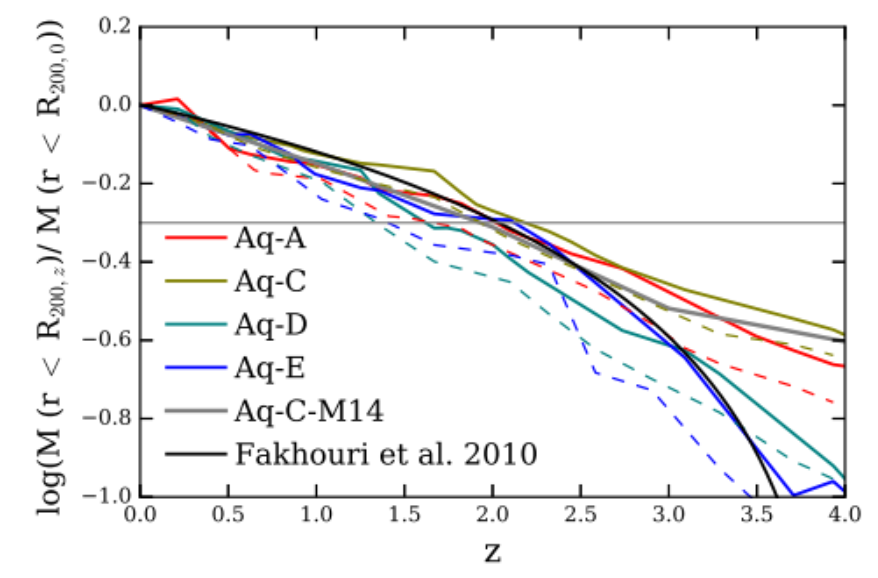
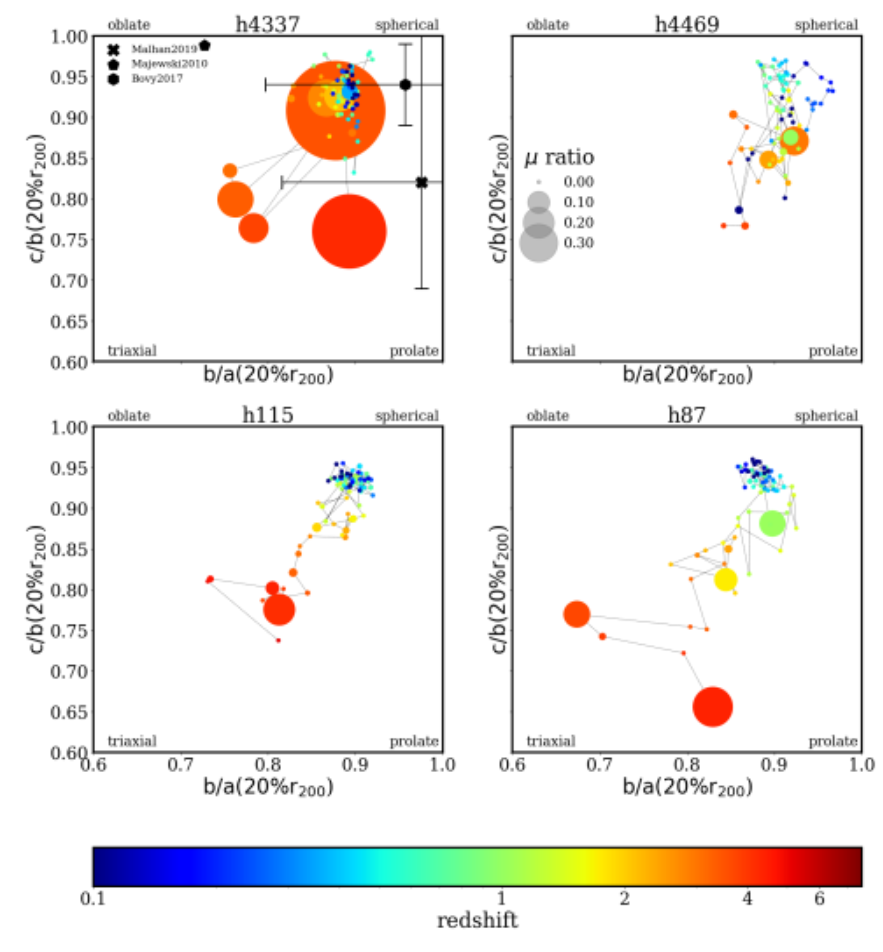
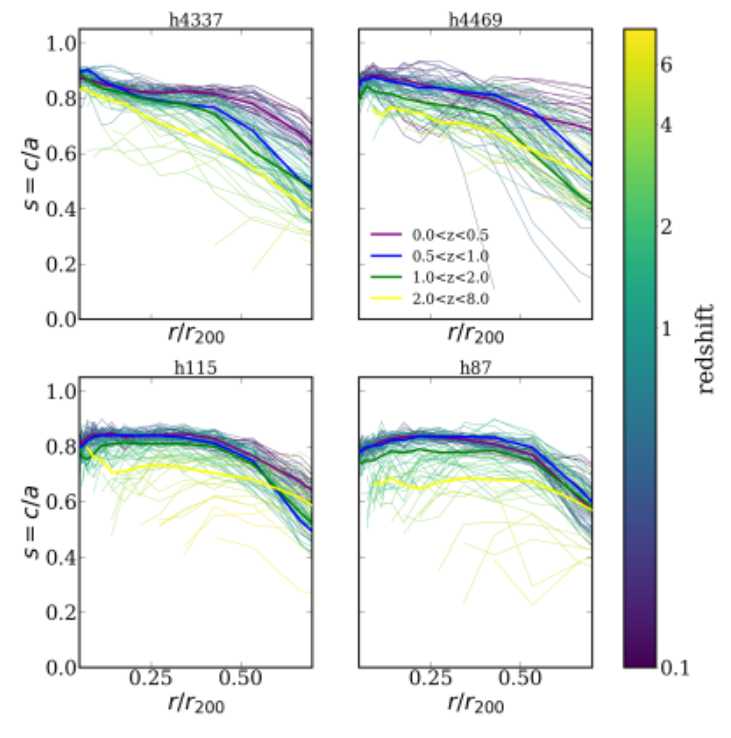
In this work, we aim at investigating the morphology evolution of Milky Way mass-like dark matter haloes selected from the CIELO and IllustrisTNG Projects. The connection between halo shapes and their environment has been studied in previous works at z=0 but their connection remains yet to be fully understood. We focus on the evolution across cosmic time of the halo shapes and the relation with the infalling material, using hydrodynamical simulations

Recommended citation: Cataldi, et. al. (2023) https://doi.org/10.1093/mnras/stad1601

Gamma Analytical Modeling Evolution (GAME) I: The physical implications of deriving the stellar mass functions from z=0 to z=8

Published in MNRAS, 2025

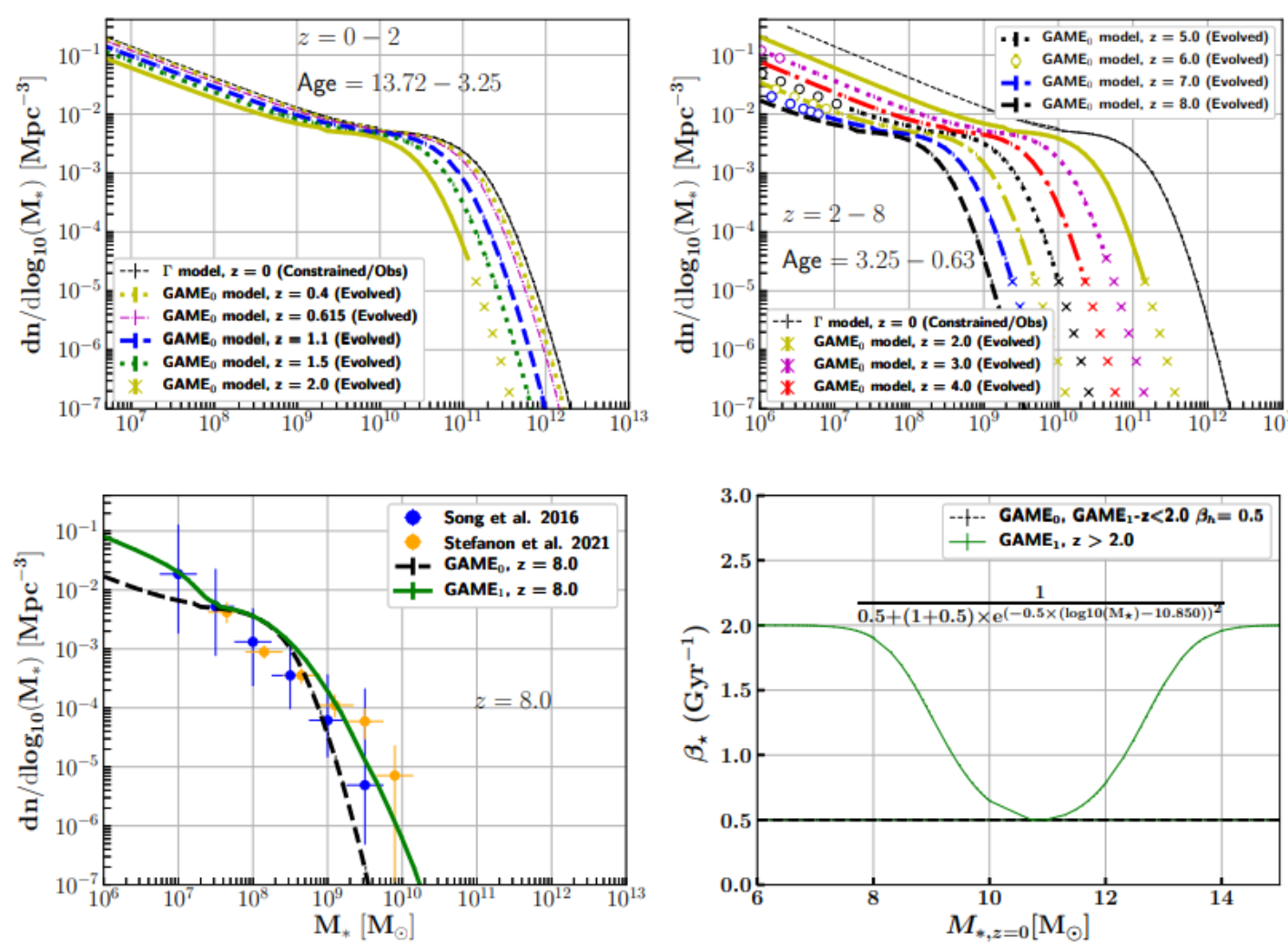
The Gamma growth model, characterised by simple parameters, successfully reproduces the evolution of the Galaxy Stellar Mass Function over 13.5 Gyr, with minor deviations at z > 1.5. This suggests that the GSMF’s evolution follows a physically motivated, few-parameter framework consistent with JWST observations.

Recommended citation: Katsianis et. al. (2025) https://academic.oup.com/mnras/article/540/1/688/8131524

Galaxy sizes and compactness at Cosmic Dawn

Published in A&A, 2025

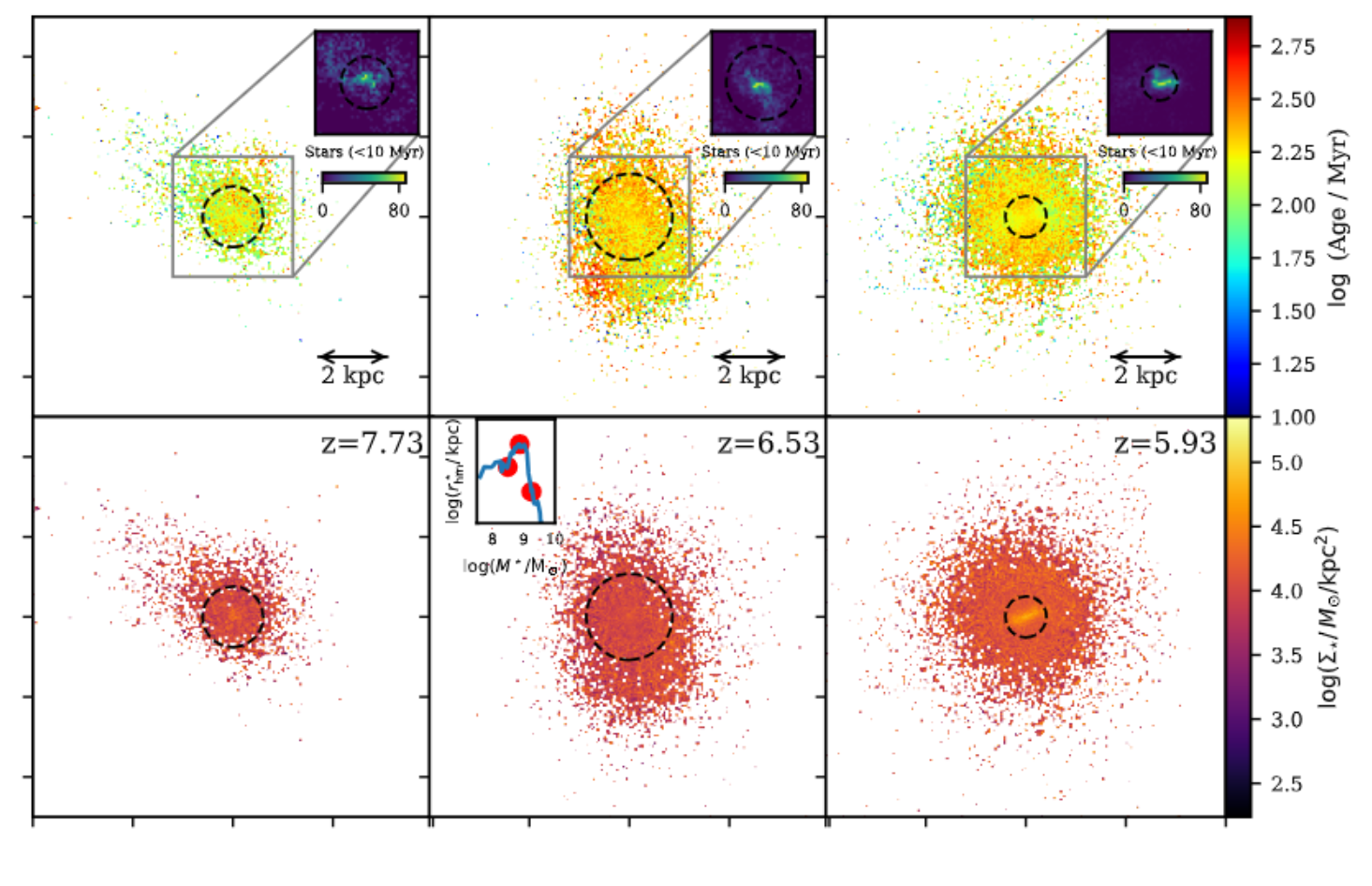
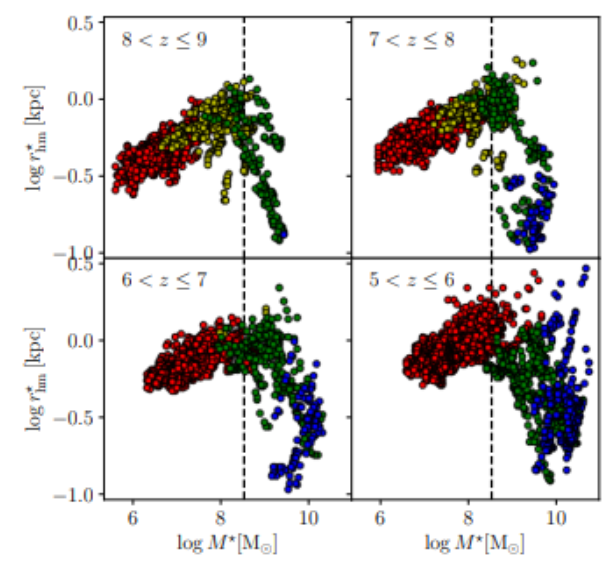
JWST has revealed ultra-compact, massive galaxies at z ≳ 6, challenging current models. Using FirstLight simulations, we find a universal wet compaction phase—an expansion–compaction–re-expansion cycle driven by central baryon domination—that naturally explains the observed inverted size–mass relation at Cosmic Dawn.

Recommended citation: Cataldi et. al. (2026) https://www.aanda.org/articles/aa/full_html/2026/02/aa56078-25/aa56078-25.html

Halo Occupation Distribution estimation performance for LSST data

Published in Submitted to A&A, 2026

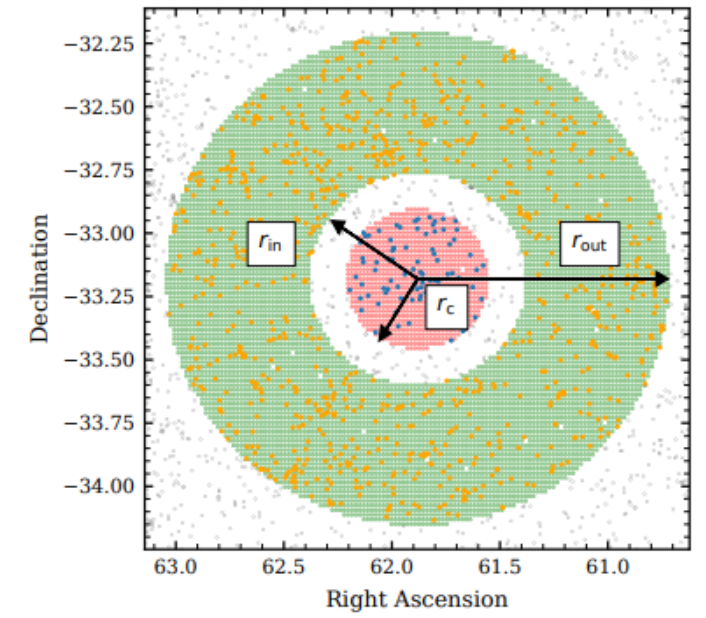
Upcoming surveys such as the Vera C. Rubin Observatory Legacy Survey of Space and Time (LSST) will measure galaxy clustering with unprecedented precision. In this project, I develop and test new methods to estimate the halo occupation distribution (HOD)—a key tool that links galaxies to their host dark matter haloes. Using realistic mock catalogues based on the cosmoDC2 simulation, I extend background subtraction techniques to work with photometric data and implement a galaxy group–finding algorithm. This work prepares robust tools to study galaxy clustering and galaxy–halo connections with future LSST observations.

Recommended citation: Cataldi et. al. (2026) http://arxiv.org/abs/2603.01978

talks

teaching

Teaching Fellow in Physics I

Undergraduate course, . Department of Physics, Buenos Aires University, Faculty of Exact and Natural Sciences, 2017

Analysis II (multivariable calculus), curse 8

Teaching Fellow in Cosmology

Undergraduate course, Department of Physics, Buenos Aires University, Faculty of Exact and Natural Sciences, 2024

Assistant teaching in Cosmology